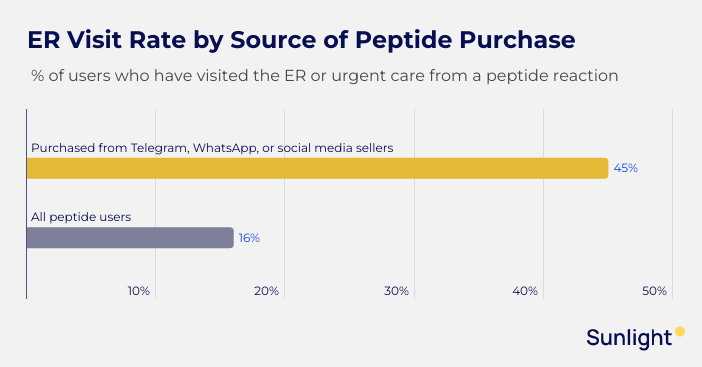
Peptide users who bought their peptides from Telegram, WhatsApp, or social media sellers ended up in the ER at nearly 3 times the rate of the average peptide user. A new Sunlight survey of 1,000 U.S. adults who use, have purchased, or are considering peptides finds that 45% of these buyers have been to the emergency room or urgent care for a peptide reaction, compared with 16% of peptide users overall.
These channels function as informal marketplaces. Buyers join enthusiast groups and message sellers directly, often factory representatives based overseas. Payment runs through cryptocurrency or electronic transfer, and shipments arrive by mail. The pattern has been documented by the DEA and reported on by NPR.
This is not a failure of doctor care. Three in four of these social-media buyers already have a doctor. The peptides they buy outside the medical system are invisible to their doctor. Those purchases drive the ER visits.
Key Findings
- Nearly half of peptide users who bought from Telegram, WhatsApp, or social media (45%) have visited the ER for a peptide reaction, compared to 16% of all peptide users.
- 3 in 4 of these buyers (75%) already have a doctor, and 76% have told their doctor about their peptide use.
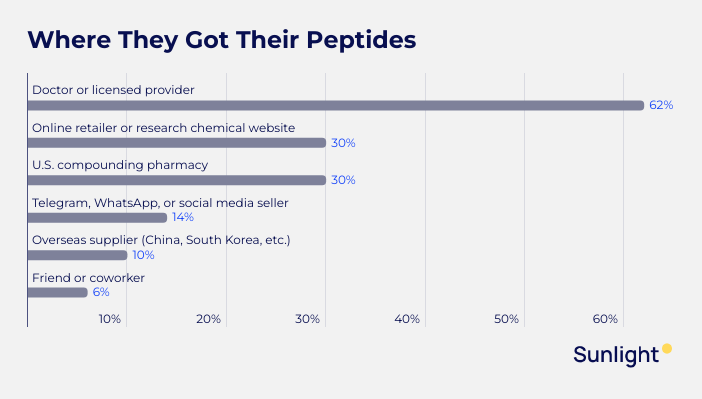
- 1 in 7 peptide users (14.5%) bought their peptides from Telegram, WhatsApp, or social media sellers.
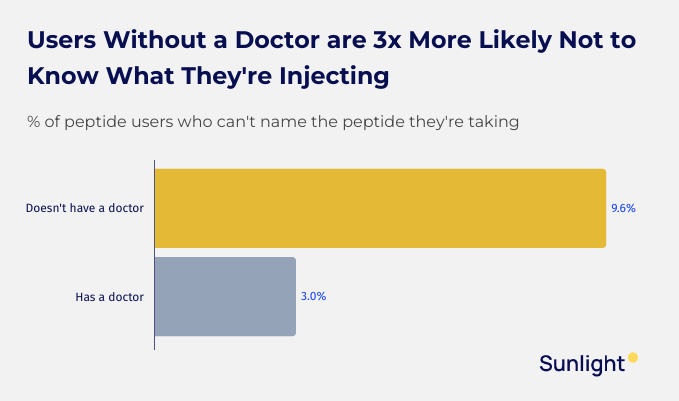
- Peptide users without a doctor are 3x more likely not to know what they’re injecting (9.6% vs. 3.0%).
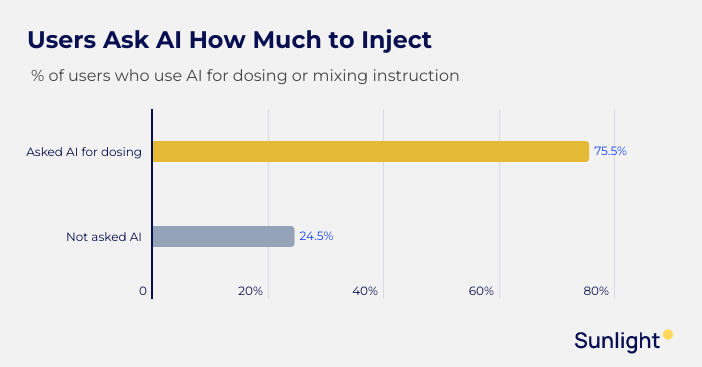
- 3 in 4 peptide users (75.5%) have asked ChatGPT or another AI tool for peptide dosing or mixing instructions.
Peptides Bought Outside Pharmacies Triple the ER Rate
Peptides bought outside licensed pharmacies are sending users to the ER at nearly 3 times the rate of the average peptide user. Among peptide users who bought from Telegram, WhatsApp, or social media sellers, 45% have visited the ER or urgent care for a peptide reaction. The ER rate across all peptide users is 16%.
The cause is not a failure of doctor relationships. 76% of these buyers have told their doctor about their peptide use, but the peptides themselves stay invisible. The doctor sees what was prescribed. The doctor does not see what was bought on Telegram.
That is why the doctor-and-pharmacy pairing functions as the safety net here. What slips through is everything bought outside it.
“While the physician is supervising one layer of the patient’s peptide use, the patient is self-managing other non-GLP-1 products through gray-market channels the physician has no visibility into,” says Dr. Angela Tran, Sunlight’s Chief Medical Advisor, who is board-certified in internal and obesity medicine. “Disclosure does not equal oversight, and that creates a false sense of clinical coverage on both sides. The gray-market products are not subject to a high tier of quality assurance, so the ER physician is often managing a contamination or sterility issue rather than a dosing error.”
1 in 7 Peptide Users Buy From Telegram or Social Media
These channels are not a fringe slice of the market. 14.5% of peptide users bought from Telegram, WhatsApp, or social media sellers. 30% got their peptides from online retailers or research chemical websites. 10% turned to overseas suppliers, including China and South Korea. 6% got them from a friend or coworker.
A doctor or licensed pharmacy is still the most common path. 62% bought through a doctor or licensed healthcare provider, and 30% bought through a U.S. compounding pharmacy. Many users bought from more than one place, so the totals add up to more than 100%.
Cost drives much of the rest. “It was cheaper to get and I didn’t have to go through a bunch of hoops to do it. It’s $400 a month. Mine is $115 a month,” said a 48-year-old woman who buys peptides through an online retailer.
What separates the non-pharmacy channels from the medical ones shows up on the package itself. Most do not put the peptide name on the label. Research chemical websites typically ship products labeled “for research use only” without dosing or identification information for the buyer.
3 in 4 Peptide Users Ask AI How Much to Inject
Most peptides bought outside the prescription system come without official dosing instructions, so users have turned to AI to figure out how much to take. 75.5% of peptide users have asked ChatGPT, Gemini, or another AI tool for peptide dosing or mixing instructions.
“I don’t have health insurance so I relied on AI,” said a 32-year-old man who buys peptides through an online retailer.
AI use is not limited to people without a doctor. 78.8% of users who told their doctor about their peptide use have also asked AI for dosing. The doctor and the chatbot are advising the same patient on the same drug, in parallel.
“AI can provide fast, accessible information about half-life, known adverse effects, and contraindications, and it can help users come up with better questions for their clinician,” adds Dr. Tran. “But a clinician can order labs, monitor markers continuously, and provide individualized management based on objective data rather than subjective information from a forum. A clinician also takes professional responsibility for the patient’s overall clinical response. AI does not share that obligation.”
Peptide Users Without a Doctor Are 3x More Likely Not to Know What They’re Injecting
These are Americans who are actively using peptides, not people thinking about trying them. The gap between users who have a doctor and users who don’t shows up most starkly in what they can name. Among peptide users who have a doctor, 3.0% cannot name the peptide they’re taking. Among peptide users without a doctor, 9.6% cannot, more than three times that rate.
Among users who can’t name their peptide at all, more than 1 in 4 (27.3%) are also unsure whether their peptides were prescribed. “It is an OTC product,” said a 56-year-old man who buys peptides through an online retailer. Peptides are not OTC.
“Patients who are medically monitored appropriately are significantly less likely to use a peptide they cannot name,” says Dr. Tran. “The clinician establishes risk stratification by understanding the patient’s medical history, current medications, metabolic status, and other comorbidities, in a way that is far superior to general information from AI and social media. The clinician provides accountability and continuity over time.”
Methodology
Sunlight commissioned this survey through Pollfish in May 2026. The sample comprised 1,000 U.S. adults who use, have purchased, or are considering injectable or oral peptides. Questions referenced in this article (ER visits, where peptides were bought, AI use, peptide knowledge) were asked of the 518 respondents who reported having used or purchased peptides.
Respondent quotes are drawn from the survey’s open-ended questions and are lightly edited only for capitalization and spelling. Quoted respondents are identified by age, gender, and sourcing channel as reported in their other survey answers.
The dominant peptide products in the survey, including GLP-1s, BPC-157, TB-500, GHK-Cu, and Melanotan, are administered subcutaneously. A small share of users may take peptides orally or nasally. The “injecting” framing in the headline reflects the dominant administration pathway in the sample.