Earlier this month, Wegovy announced the availability of its new GLP-1 pill. In January 2026, Sunlight.com surveyed 2,000 overweight Americans to assess their awareness of and interest in GLP-1 medications in pill form. The survey examined past and current use of GLP-1s for weight loss, barriers to initiation, reasons for discontinuation, and interest in switching from injectable medications to oral options.
Based on Sunlight.com’s survey of 2,000 U.S. adults:
- Nearly half of overweight Americans report having taken a GLP-1 for weight loss, including many who are currently using the medication.
- A sizable share of people who have never taken a GLP-1 say reluctance to take injections has prevented them from starting.
- Among people who stopped taking a GLP-1, cost and side effects are the most common reasons for discontinuation; however, injections also play a role.
- 4 in 10 people not currently taking a GLP-1 say they are likely to start one in 2026, and nearly half say they would prefer a pill.
- Most current GLP-1 users are interested in switching to a pill, and many have already taken steps to do so.
Injections Have Been a Barrier for Non-Users
Nearly half of overweight Americans (49%) report having taken a GLP-1 for weight loss. This includes 39% who report currently taking a GLP-1 and 10% who have taken one but stopped.
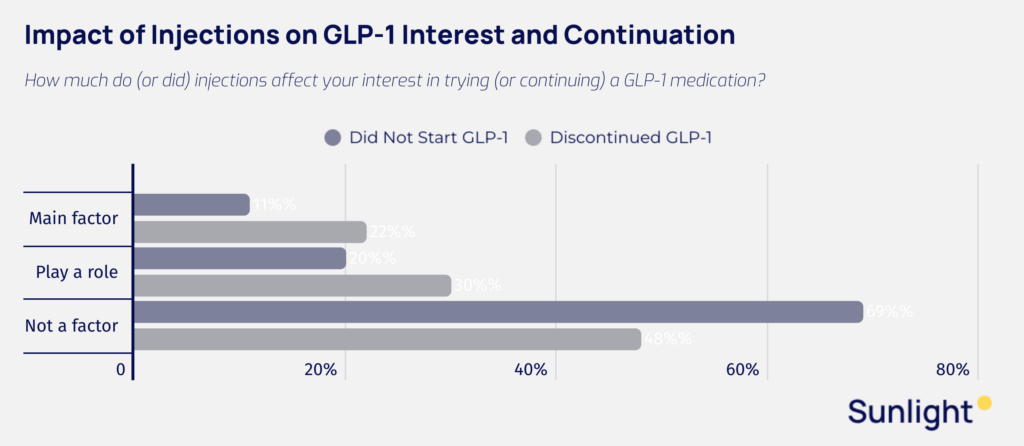
Among people who have never taken a GLP-1 for weight loss, 30% say the fact that the medication requires injections played a role in their decision not to start. For 11%, injections were the main reason they have not tried a GLP-1. People in this group commonly cite concerns about discomfort or pain, intimidation about self-injecting, and fear of needles.
Among people who took a GLP-1 in the past but stopped, 22% say injections were the main reason they discontinued treatment, and 30% say injections were one of the reasons they stopped. Some noted infections were uncomfortable or painful, while others found self-injecting intimidating. However, cost and side effects were cited more often as reasons for discontinuation. Nearly half of past users (45%) say cost was a factor, and 41% cite side effects.
Most past users stayed on the medication for at least several months. Only 7% report discontinuing within one month or less of starting, and nearly all (97%) report discontinuation within the first year.
“After years of only having injectable GLP-1s, it’s exciting that patients may have both a pill and an injection option. Oral GLP-1s can be advantageous for many people because taking a daily pill avoids needles, potential injection-site reactions, and issues with vials or dosing units. They can also be especially helpful for travel, since injections often require refrigeration, and oral options may be easier for long-term maintenance and may have lower out-of-pocket costs,” says Dr. Angela Tran, Sunlight.com’s chief medical advisor.
“The tradeoff is that injections tend to have more predictable absorption, while oral pills come with strict timing instructions, and missing daily doses can affect effectiveness. Oral pills may also require higher doses to achieve similar weight-loss results compared with injections.”
4 in 10 Overweight Americans Say They’re Likely To Start a GLP-1 in 2026, and Most Prefer a Pill
Among overweight Americans who are not currently taking a GLP-1, 42% say they are likely to start one in 2026.
When asked which method they would prefer, nearly half (47%) say they would take a GLP-1 in pill form. By comparison, 24% say they would prefer an injectable medication, while the remaining respondents say they are unsure.
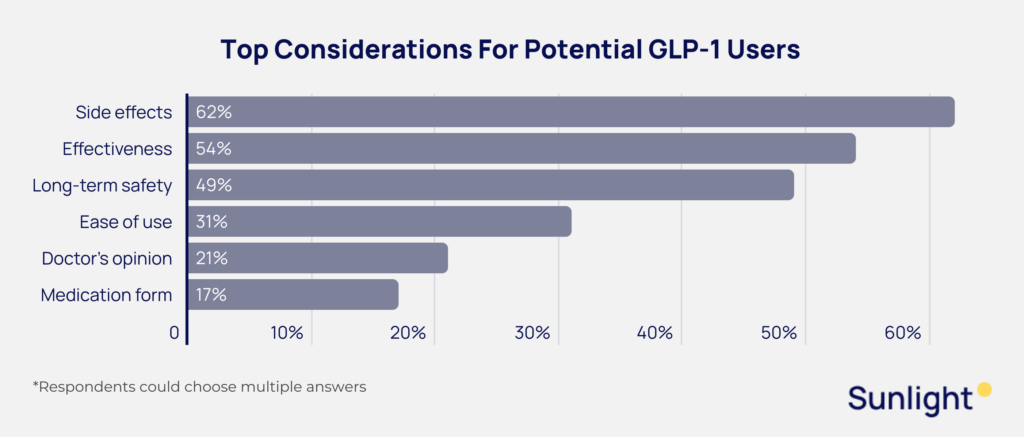
Cost and side effects are the dominant considerations for those looking to start a GLP-1. Seven in 10 (70%) say cost is a key factor, followed by side effects (62%) and effectiveness (54%).
Nearly 9 in 10 Current GLP-1 Users Are Interested in Switching to a Pill
Among people currently taking a GLP-1, 74% say they take an injectable medication and 26% say they take a pill. Many users who administer injections report discomfort with this method.
Most current GLP-1 users express interest in switching to an oral medication. Overall, 87% say they are interested in switching to a pill, including 59% who are very interested and 28% who are somewhat interested.
Current oral users commonly cite convenience and a preference to avoid injections as their primary reasons for taking a pill. These are also the most common reasons those currently injecting say they are considering switching.
Nearly half of those who want to switch to an oral GLP-1 have already taken steps
Among people interested in switching from injections to a GLP-1 pill, 43% say they have already taken steps toward making the change. The most common actions include consulting a doctor, researching pill options, and verifying insurance coverage. Specifically, 62% say they have asked their doctor about switching to GLP-1 pills, 58% have researched GLP-1 pills online, and 57% have checked whether their insurance would cover the pills.
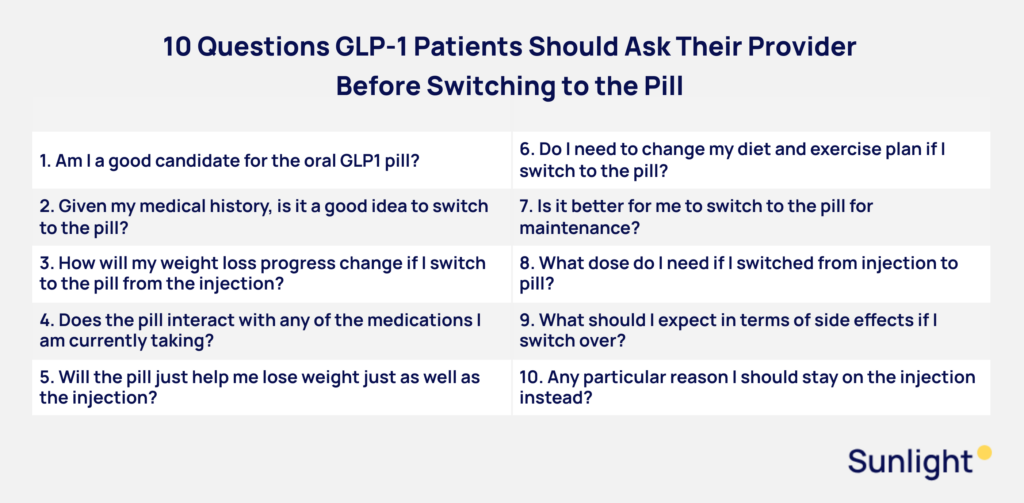
Questions GLP-1 Users Should Ask Their Provider Before Switching to a Pill
“Switching from an injectable GLP-1 to a pill is something patients should do with an experienced medical provider,” explains Dr. Tran. “The key questions are: ‘Am I a good candidate?’ ‘Is switching appropriate given my medical history?’ ‘How might my weight-loss progress change?’ ‘Will the pill work as well as the injection?’ and ‘Could it interact with my other medications?’ Patients should also ask about dose, side effects, whether they need to change diet and exercise, whether it’s better for maintenance, and whether there’s any reason to stay on the injection.”
Methodology
Sunlight.com surveyed 2,000 overweight U.S. adults in January 2026 via Pollfish, an online survey platform. Respondents self-identified as overweight at the time of the survey. The survey assessed awareness, interest, and use of GLP-1 medications in pill and injectable forms for weight loss, including barriers to initiation, reasons for discontinuation, likelihood of starting GLP-1 treatment in 2026, and interest in switching from injections to an oral option. Responses were screened for quality control. Results are reported at a 95% confidence level with a margin of error of ±2.2 percentage points for the full sample. All data is self-reported. Percentages may not total 100% due to rounding or because respondents were permitted to select multiple responses where applicable.