- Key Findings
- 3 in 10 Hiring Managers Say a Candidate’s Weight Influences Their First Impression
- Overweight Workers Face Pay and Promotion Penalties
- Half of Hiring Managers Hold Negative Stereotypes About Overweight Workers
- Men and Mid-career Managers Show the Highest Levels of Weight Bias
- Nearly 1 in 3 Companies Encourage Employees To Use GLP-1 Medications
- Methodology
Weight discrimination in the workplace is widespread. A new survey of 1,000 U.S. hiring managers, conducted by Sunlight.com, finds that weight bias shapes hiring, compensation, and promotion decisions.
The findings paint a troubling picture: overweight job candidates are less likely to be hired, less likely to be promoted, and more likely to receive smaller raises.
Key Findings
- 19% of hiring managers say they’re less likely to hire an overweight candidate.
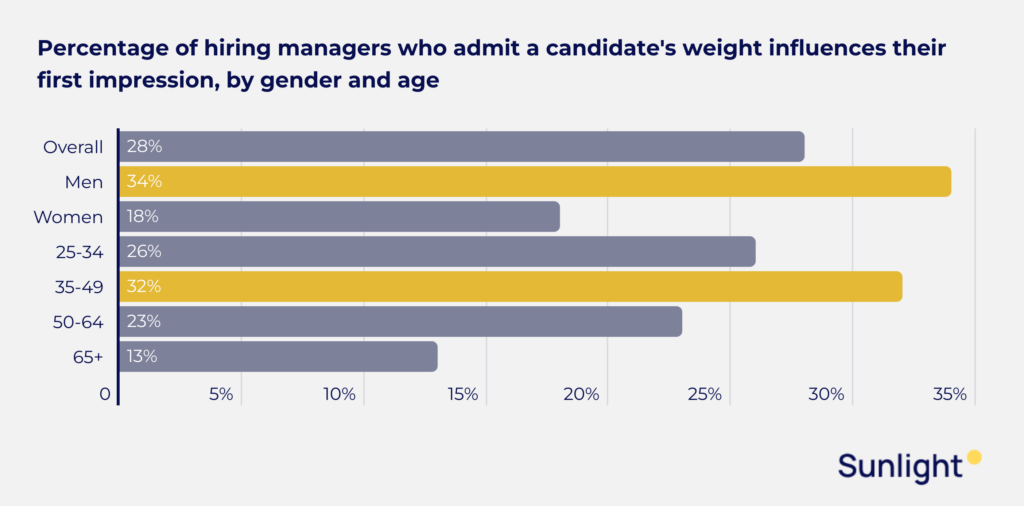
- 28% say a candidate’s weight influences their first impression, and 14% say they’ve given overweight candidates worse job offers.
- 17% admit they have given overweight employees smaller raises.
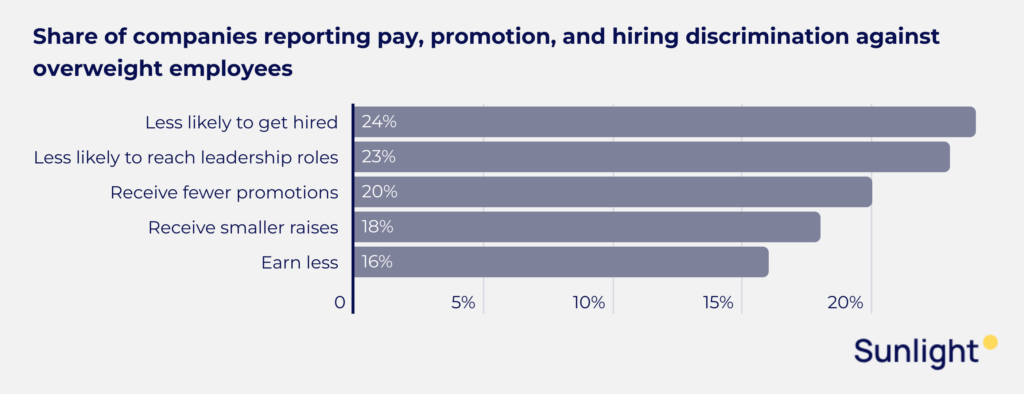
- Nearly 1 in 4 hiring managers believe overweight employees are less likely to reach executive or leadership roles at their company.
- Male hiring managers are more biased, and are nearly twice as likely to say weight influences their first impression of a candidate (34% vs. 18%).
- Mid-career managers are most likely to be biased against overweight workers.
- 30% of companies encourage employees to use GLP-1 medications for weight management.
3 in 10 Hiring Managers Say a Candidate’s Weight Influences Their First Impression
Nearly three in ten (28%) of hiring managers surveyed say a candidate’s weight influences their first impression, and 19% admit they are less likely to hire an overweight job candidate. Additionally, 14% of managers admit they have given overweight candidates worse job offers because of their weight.
“There’s no medical evidence that body weight predicts job performance or correlates with productivity, competence, leadership, or work quality,” says Sunlight’s Chief Medical Advisor, Angela Tran. “In physically demanding jobs, abilities like strength, mobility, and stamina matter more than weight. Weight bias is well documented in hiring and promotions, and while it can function like race or gender bias, weight isn’t protected in most states.”
Overweight Workers Face Pay and Promotion Penalties
Weight bias does not disappear once an employee is hired. Seventeen percent of managers say they have given overweight employees smaller raises because of their weight, and 14% say they are less likely to promote an overweight employee.
Looking at company-wide patterns, 20% of managers say overweight employees at their company are less likely to receive promotions, and 18% say overweight employees receive smaller raises overall. Additionally, 16% say overweight employees on average earn less than non-overweight employees.
Nearly 1 in 4 managers (23%) say overweight employees are less likely to reach executive or leadership roles at their company, and 24% say overweight employees are less likely to be hired.
Hiring managers in technology and software are most likely to say their company is less likely to hire overweight candidates (36%), followed by those in manufacturing (33%), finance, banking, and insurance (32%), retail and e-commerce (24%), and consulting and professional services (22%).
“Obesity used to be framed mainly as a willpower or lifestyle issue, but it’s now understood as a complex metabolic disease influenced by genetics and hormones that regulate appetite and metabolism,” says Dr. Tran. “The ‘eat less, move more’ narrative persists despite this shift, and outdated views still drive stereotypes about discipline and capability. GLP-1 medications reflect this newer understanding by targeting underlying physiology, often alongside lifestyle and behavioral changes.”
Half of Hiring Managers Hold Negative Stereotypes About Overweight Workers
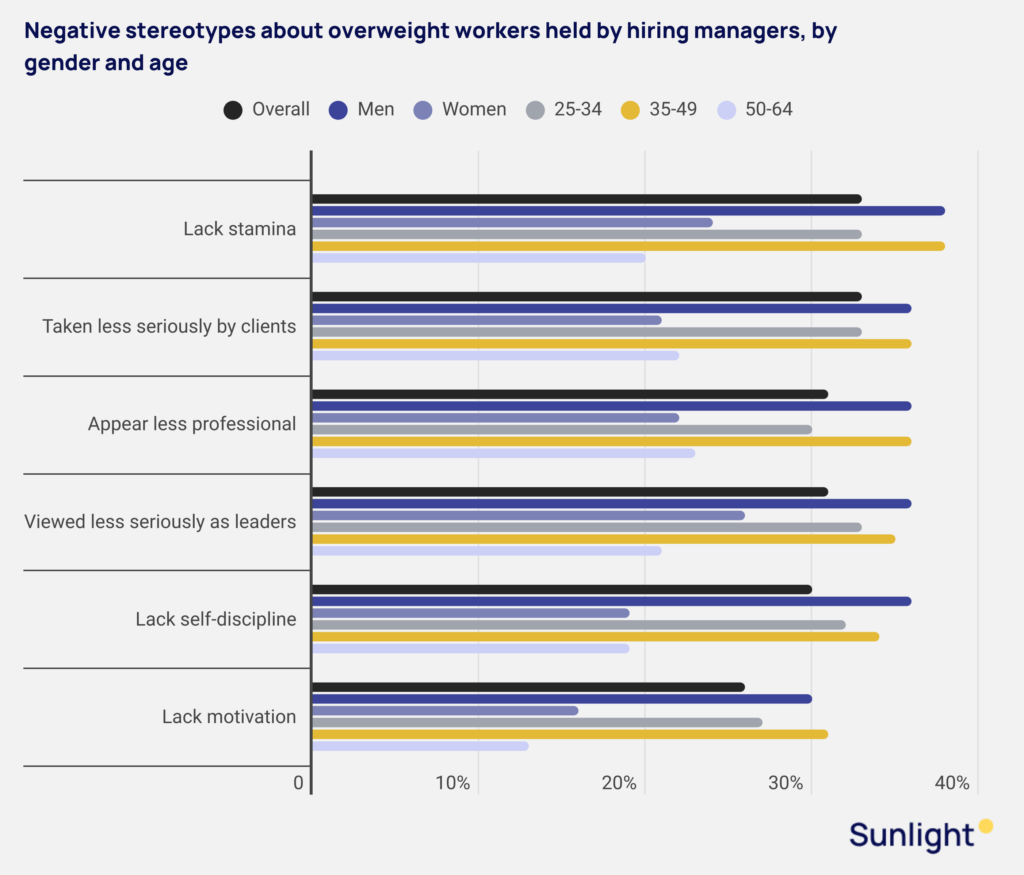
Half of managers admitted to holding at least one negative assumption about overweight employees. Thirty percent believe overweight workers lack self-discipline, 33% say they lack stamina, and 31% say they appear less professional. More than three in 10 believe overweight employees are taken less seriously by clients, and an equal share say the same about their leadership credibility.

Men and Mid-career Managers Show the Highest Levels of Weight Bias
Weight bias is not evenly distributed among managers. Men are significantly more likely than women to report discriminating based on weight across every measure in the survey. Thirty-four percent of male managers say a candidate’s weight influences their first impression, compared to 18% of female managers. Men are also more likely to say they are less likely to hire (21% vs. 16%) or promote (16% vs. 11%) an overweight employee, and more likely to admit to giving smaller raises (21% vs. 11%).
Age plays a role as well. Looking at managers’ own beliefs, the 35-to-49 age group consistently shows the highest bias. Twenty-one percent say they have given overweight employees smaller raises, compared to 17% of managers aged 25 to 34 and just 9% of those aged 50 to 64. On stereotypes, 35-to-49-year-old managers are also the most likely to agree that overweight employees lack stamina (38%), appear less professional (35%), and are taken less seriously as leaders (35%).
“Weight-based discrimination has measurable health effects, including higher depression and anxiety, increased stress and cortisol, poor sleep, headaches, and higher risk of metabolic disease,” says Dr. Tran. “Body size alone does not reliably predict stamina, cognitive performance, or leadership abilities, and there’s no consistent evidence whatsoever that body size predicts intelligence, attention, memory, or decision-making.”
Nearly 1 in 3 Companies Encourage Employees To Use GLP-1 Medications
Thirty percent of managers say their company encourages employees to use GLP-1 medications, such as Ozempic or Wegovy, for weight management. Whether that reflects a genuine commitment to employee health or an extension of workplace weight bias remains an open question.
“Employers shouldn’t be encouraging employees to take GLP-1s because it can create pressure and raise legal and privacy concerns,” says Dr. Tran. “The appropriate role is offering insurance coverage and neutral education so employees can make independent medical decisions with their providers.”
Methodology
In February 2026, Sunlight.com surveyed 1,000 U.S. hiring managers ages 25 to 65 who are employed full-time and involved in hiring decisions at their company. To qualify for the survey, respondents had to be employed full-time, have a household income of at least $75,000, and a bachelor’s degree or higher. The survey was conducted online. Quality checks were applied to identify and remove inattentive or invalid responses.